The first time I came across Sussex frescoes & wall paintings, they stopped me in my tracks. I say the first time but that’s probably not true. I suspect, when I was younger, I probably saw many a fresco in the various Sussex churches of my youth but the significance of paintings etched hundreds of years ago passed me by.

It was the Medieval frescoes at St Botolph’s at Hardham near Pulborough a few years ago that ignited my interest and sent me down a fresco rabbit hole. Not for any religious reasons but because of the direct connection these raw paintings (many of which are nearly a thousand years old) create with the artist/s. The human being that stood where you stand now, seeing what you see now with only the centuries between you and the drying paint. The paintings themselves are like primitive photographs and insights into another time and that is special enough but is that tangible connection to the artists that mean these ancient paintings always send a tingle down my spine.

Since my Hardham epiphany, whenever I get wind of a fresco, I head off to find it. And what’ve I found is that Sussex is awash with these emotive, historic and strangely compelling paintings. So here are some of those that I have found so far.

St Botolph’s Church, Hardham
This tiny 11th century church (probably built in 1060) claims to have the oldest wall paintings in the country. They are part of the Lewes Group and are believed to have been painted in the late 11th / early 12th century. The paintings are one of the most complete series and include depictions of St. George, the Annunciation and Adam and Eve.

The paintings are now on the Heritage England’s risk register as the colours are fading but none the less, they still have the ability to elicit a gasp. They were uncovered in the mid 19th century as like many, they had been covered over during the Reformation.

While you are at this church, walk around the back to see the Squint, which was once a hole in the wall, through which an anchorite who was living in a cell outside the church in isolation could see into the chancel.
The Lewes Group is a group of five churches (Clayton, Coombes, Hardham, Plumpton and Westmeston – although the wall paintings at Westmeston have been destroyed) with related schemes of wall painting from the period 1080 to 1120. It’s believed there is a connection between the paintings and Lewes Priory and that they were the work of a single travelling workshop of artists.

St Mary’s Church, West Chiltington
St Mary’s Church at West Chiltington is another church that elicits a wow and is in my top three! Probably built between 1100 and 1150 (with later additions), the frescoes here were uncovered in 1882. They date from the 12th to the 14th century.

The paintings cover the south aisle, the arches and the south wall of the nave. They depict the apostles, decorative patterns, a nativity cycle, the resurrection, an endless knot, Christ and St Christopher. The detail and colour is incredible.

The church also has a type of Squint known as a hagioscope which was used for someone standing in the south aisle to view the celebrant.

St Peter ad Vincula Church, Wisborough Green
This church has a commanding position, a 12th century nave and a 13th century wall painting. Dated to about 1199 to 1216 (and rediscovered in 1867), this is a really striking painting.

It shows Christ (unusually wearing a crown) and St James leading pilgrims to Compostella. The colour and detail are particularly vivid and compelling and it’s incredible to think King John was on the throne when this was painted.

St Helen’s Church, Hangleton
Once a country church set on open download, this 11th century church (with later additions) now sits in a residential suburb of Hove.

Paintings were first uncovered here in the late 1960s, and the work includes simple scrolls and foliage in window arches and scrollwork on the north wall.

These paintings are probably early 13th century. There has been some overpainting in later centuries but there still remains some fascinating detail. The church is a little haunting, reminiscent as it is of a bygone time, and there is also a fascinating tombstone to look out for.

St Botolph’s Church, Botolph
The simplicity of this 11th century (with later additions) church is compelling as it stands in an isolated corner not far from the banks of the river Adur.

The frescoes here are a little faint and faded and were found in the 1930s.

There seems to be some debate as to the age and significance of the paintings with some arguing they may have been part of the Lewes Group (the church at Coombes is just down the road) but they may also be 14th century. There is also a 17th century font and pulpit here.

Coombes Church (dedication unknown), Coombes
Another hauntingly remote downland church which echoes with the lives of a distant time. The nave here is 11th century and the wall paintings are part of the Lewes Group.

They were uncovered in 1949 and some of them are particularly detailed, vivid and exotic. In fact, it’s this vibrancy and style that has led some to suggest they might not have been part of the Lewes Group because they are more sophisticated.

The oldest painting is thought to date to 1135 and they depict a number of scenes including the Visitation, the nativity and Christ delivering the keys to Heaven to St Peter.

St George’s Church, Trotton
The wall paintings here are some of my favourites. Both the church and the paintings are 14th century and they depict the Last Judgement and Jesus Christ underneath Moses.

To the right is Carnal Man surrounded by the Seven Deadly Sins and to the left is Spiritual Man surrounded by the Seven Acts of Mercy. They are absolutely compelling and were discovered in 1904.

These aren’t the only paintings here and others include paintings of the Camoys family probably dated to the 15th century.

St John the Baptist Church, Clayton
At the foot of the South Downs and not far from the Jack and Jill windmills, this is another church in the Lewes Group.

The church is 11th century (with later additions) and the paintings were discovered in 1893. These show Christ in Judgment, seated in a mandorla, supported by an angel on each side, and with six Apostles.

There are a variety of other images which include a mounted figure, the Horsemen of the Apocalypse, an angel weighing souls and the dead rising from their graves.

St Peter’s Church, Southease
North of Newhaven, the 11th century nave of this church may be pre-Norman Conquest.

The round town is one of only three in Sussex (the other two being St Michael’s church in Lewes and St John the Evangelist in Piddinghoe).

There are paintings on the north and west walls discovered in the 1930s and thought to be 13th or early 14th century. They are a bit faded but show scenes from the Life of Christ.

St George’s Church, West Grinstead
The oldest part of this church dates from the early 11th century with additions in the 12th and 13th centuries. A south chapel was added in the 14th century. The 15th or 16th century wall paintings were discovered in 1890 and although no longer vivid, show St Christopher against a city background.

If you are in the area, just down the road is the Church of Our Lady of Consolation and Saint Francis which is where, in 1953, the writer and historian Hilaire Belloc was buried.

St Mary’s Church, Battle
When visiting Battle, it can be easy to forget to visit the church next to the abbey.

Dating back to the 12th century, there are a number of reasons to visit including the 15th century brasses, an impressive font, a monument of Sir Anthony Browne (also of Midhurst) and some interesting glass windows.

The wall paintings were uncovered in 1845 and then recovered until 1867 as a result some have been lost. They date from about 1300 and show the life of St Margaret and are detailed and skilled.
St Michael Church, Up Marden
This church which probably dates from the 13th century has a touch of simplicity about it although it has been restored and altered many times over the centuries.

The wall paintings were uncovered as recently as 1994 and probably date to the 13th century. The colours are still bright although the images are a little hard to pick out. One of them (which I thought looked like Father Christmas) is probably a 15th century painting of St Christopher with a staff.

This church is one of the Octagon Parish churches and on the Octagon Way.
St Richard’s Church, Burton Park, Petworth
This tiny, two celled, 11th century church is compelling, standing proud in its own simplicity next to an extravagant mansion.
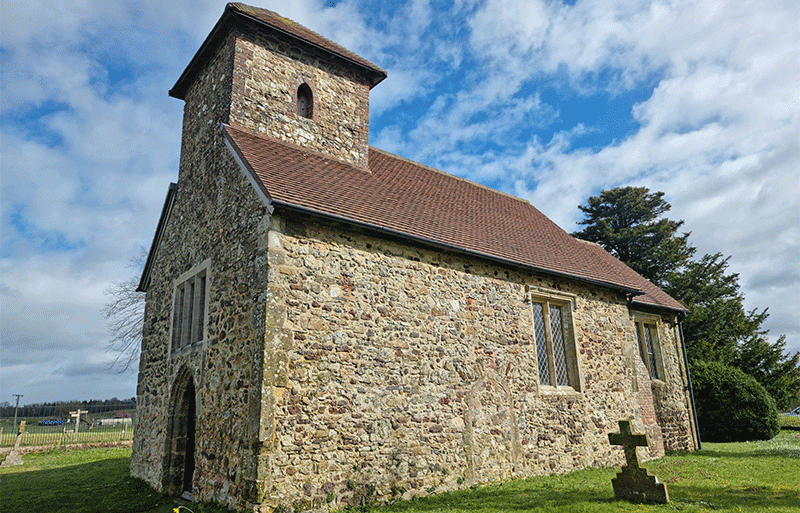
Once again, there are a number of reasons to visit, which include some significant 16th century brasses, an 11th century font and a 15th century effigy.

A striking wall painting (almost hidden from view) is an orange image of a female upside down on a diagonal cross which probably dates to the early 16th century. It is thought to be St Wilgefortis, a Christian Portuguese princess from about 130 AD who refused to marry the man her father has chosen for her. She decided instead to become a nun but her father imprisoned her so she prayed to become ugly. The legend is that she then grew a beard and her furious father ordered her crucifixion. There is also a Royal Arms painted on the wall in 1636.

My fascination with and search for Sussex frescoes and wall paintings continues. But if you like this article, you may also like:


