Tim Barlow is a popular and well known Hastings poet, as well as a contributor to the recently published Poet Town anthology. Here, he talks about the Hastings poetry scene, his own poems and poetry journey and why poetry matters.

www.maxinesilver.co.uk
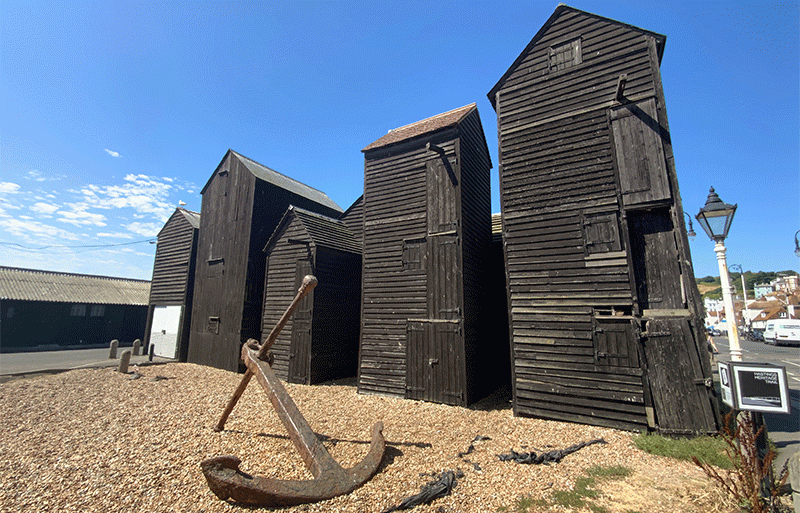
I’ve lived in Hastings for 11 years now. I’m Derbyshire born and bred, migrated south via London, and like so many new parents we swapped a tiny one-bed flat for a house by the sea. We already knew Hastings from weekend visits to friends, but one day, standing on West Hill looking across the rooftops of the Old Town and out to sea, we thought: We could live here. We’ve never looked back. And if Hastings is the end of the line, then Rock-a-Nore is the end of Hastings, and that’s my favourite place: the cliffs at sunset, the Old Town behind you with its smuggling history, fishing, and 600-year-old houses. It’s special.

The Hastings poetry scene
Hastings is bohemian and busy, but also honest about its rough edges. There are social problems: deprivation, homelessness, the realities many seaside towns face. And yet if you move here you quickly discover that whatever you love, there’s a group for it: visual arts, drama, pottery, writing, and—more than you might expect—poetry. And in terms of poetry, there is so much going on. There is A Load of Poets held at Twelve Hundred Postcards (second Thursday monthly, 7.30pm). This is a poetry open mic session and twenty-plus readers is common, so it’s five minutes each. All free. Put your name down on the night. Old hands and brand-new voices share the same mic.
But there is also a stanza group for page-based critique; Poetry for the People; and a poetry salon where we read a major work together—last weekend it was T. S. Eliot’s Four Quartets, 21 of us taking turns round the circle. Poet Town certainly didn’t invent the scene but it’s caught the moment—pulled threads together, introduced strangers, sparked new events. It feels like a lid lifting.

www.maxinesilver.co.uk
The tenderness of life
I’d long written, but three years ago I wandered into one of those open mic at Twelve Hundred Postcards on Queens Road—out of curiosity at first, but then entranced. I read two new poems the following month, hands shaking so much I stuck my paper to cardboard to stop it flapping. Since then I’ve done around a hundred performances, sometimes hosting the night, and one thing keeps leading to another: a breakfast-show reading here, a library tour supporting Henry Normal across East Sussex’s 17 public libraries. I’m now working with Flapjack Press (Manchester) on a first collection, due January.
I feel blessed to be included among 53 modern poets in Poet Town. One of my poems in the collection is The Horsepower of Love. Despite the subject, it’s not autobiographical—it began with a single word that popped up in conversation: petrosexual. I thought, What a great word—there’s a poem in that. It’s become one of my favourite pieces to perform live; the final line always lands. The other of my poems in the book is Just Coming Up to My Finest. Years ago, I knew an elderly regular in a pub, Terry, who would hobble in on his stick and, when asked how he was, always said, “Just coming up to my finest.” It raised a laugh precisely because he obviously wasn’t. The poem started there—with tenderness for the stoicism and comedy of everyday life.

Personal favourites
One of my favourite pieces in Poet Town is Penny Pepper’s A Spoken Word Love Poem. It’s sharp, funny, and full of energy, with a brilliant twist at the end that never fails to surprise the audience. Penny is also a fantastic live performer, and seeing her bring the poem to life adds an extra spark to the words on the page.
Another highlight for me comes from Henry Normal. His poem, which closes the modern section of the anthology, ends with the resonant lines: “These are the better days. These are the better days.” It’s deceptively simple, but so powerful — a reminder that the moments we often overlook or wish away may, in fact, be the best ones of all. Whenever I hear it performed, it draws a collective sigh from the audience. And of course, George Macdonald’s The Shortest and Sweetest of Songs is simply brilliant at just two words long.

Why poetry matters (especially now)
In 2025, poetry—especially performance poetry—is a small act of rebellion. Instead of staying home to scroll and buy, you write, go out, read to others and talk. It drags us off our phones and into a shared, civic space. You get an instant response you rarely get from other forms: laughter, a hush, the quick inhalation before applause. It’s also a courage practice. My first night, my hands shook; now the stage feels like a second room in the house. Say yes and it multiplies—gigs lead to tours, friendships, books.
For writers, poetry is the purest form of craft: precise words, the best shape, the truest image, succinct and memorable. For readers (and listeners) it’s a way to vent, grieve, love, think. Open mics often carry intense emotion—people getting something off their chest—but there’s just as much humour, curiosity and surprise. A poem can be two words (“Come home.” — George MacDonald) and still contain a novel’s worth of feeling. And that’s Hastings all over: layers—beauty and grit; history and now; Old Town and new.
What next?
Poet Town has got its own Hastings Book Festival event, and I’m taking part in National Poetry Day (2 October) at Lewes Library with five other poets from the book—reading our work, sharing classics and talking about what binds it all together. There’s also a lively Facebook group (≈1,200 people) around the project. It feels like more than a book; it’s a gathering point— and a very Hastings one at that.
For more information about Poet Town and some of the other poets, visit:
To explore the area, visit:


