Many long and learned books have been written on the subject of Sussex history. After all, with a county that dates back to the Jurassic and Cretaceous periods, there is plenty of history to write about. So in this potted history of Sussex, we cannot and do not pretend to be producing a fully detailed, weighty tome. Instead, here, what you will find is a summary of the main eras that have brought us from dinosaurs and subtropical plains to vineyards and elegant seaside towns, and a summary of some of the events that, along the way, have shaped the places and people of Sussex.

The Jurassic and Cretaceous periods & Sussex dinosaurs
Dinosaurs lived approximately 200 million to 66 million years ago during the Jurassic and Cretaceous periods. Back then, Sussex was warm and watery (think subtropical river plains and swamps).

Sussex and the Sussex coast are well known for their dinosaur finds. Iguanodon teeth were discovered in about 1822 by Gideon Mantell and his wife Mary Ann Mantell near Cuckfield, evidence of Hylaeosaurus was found at Tilgate Park near Crawley, while other species have been found at Horsham. Dinosaur teeth have also been found at Bexhill and fossils and footprints can be found both at Bexhill and along the coast between Pett Level and Hastings.

Formation of the Downs
About 100 million years on, the sea started to rise, the area became a shallow and tropical sea, and chalk and flints were deposited. These started to form a dome, partly due to tectonic movements pushing the chalk into this shape. But gradually, the centre part eroded away, by reason of rain, frost, rivers and Ice Age processes, leaving the hard chalky outer core (the North and South Downs) and the soft clay and sandstone of the Weald in between. And so our Sussex landscape started to take shape.

The arrival of man and prehistoric Sussex
Our earliest ancestors arrived in England about 900,000 years ago, towards the end of the Ice Age, although perhaps not man as we know it. The first evidence of human life in Sussex dates to about 480,000 years ago, in the shape of the remains of the Boxgrove Man found near Chichester. Modern humans appeared about 40,000 to 45,000 years ago with permanent settlement beginning about 12,000 years ago. Tools thought to be from 35,000 years have been found at Pulborough and there are about 25 known prehistoric hillfort enclosures in Sussex. Until about 10,00 years ago, Britain was still connected to Europe by a landmass but as the Ice Age ended and the sea levels rose, Britain gradually became an island.

The Stone Age
During the Stone Age, hunter-gatherers moved through woodland and along river valleys, using flint tools to catch food. By the Neolithic period (towards the end of the Stone Age) farming communities had begun clearing forests, building long barrows for their dead and raising earthworks such as those found across the South Downs. Whitehawk Camp is one of Britain’s earliest Stone Age monuments. Dating to about 5,500 years ago, it was a place of celebration, burials and other rituals. There are also Neolithic flint mines that date to around 4000 BC on the South Downs, and Stone Age flint hand axes have been found at Boxgrove.

The Bronze Age
The first metal weapons and jewellery began to arrive in Britain in about 2,300 BC as did a new kind of pottery known as Beaker. The Beaker people named after their distinctive pottery arrived from Europe and replaced much of the Neolithic population, taking Britain from Stone Age to Iron Age. The Bronze Age was an era of trade between Sussex and both wider Britain and Europe. Sussex would have seen fenced farmsteads and maybe even fields start to emerge. Bronze Age sites in Sussex include Cissbury Ring, Chanctonbury Ring, Kingley Vale, and Highdown.

The Iron Age
The Iron Age saw bigger and better hillforts with weapons made out of metal. There is even evidence of iron working at sites near Crowhurst and Sedlescombe in East Sussex. There are numerous Iron Age hill forts in Sussex, for example, at Cissbury, Chanctonbury, Devil’s Dyke, Ditchling and more. The Iron Age came to an end with the arrival of the Romans.

All hail the Romans
By the time the Romans arrived in AD 43, Sussex was already a settled and cultivated landscape shaped by thousands of years of human activity. The Romans stayed until AD 410.
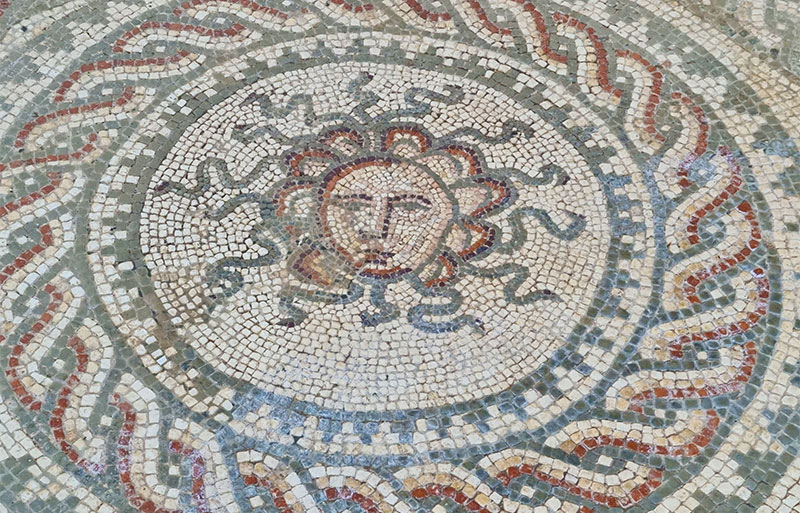
Their first major Sussex settlement was beleived to be at Noviomagus Reginorum (Chichester) and Roman palaces have been found at nearby Fishbourne and Bignor with other Roman remains at Angmering, Arundel, Southwick, West Blatchington, Chilgrove, Up Marden and further away at Wolstonbury and Pevensey. Of course, the Romans also left behind Stane Street, a straight road from Chichester to London which still exists. The Romans also exploited the Sussex Weald for iron ore and had a series of ports along the coast for trade with Gaul.

Saxon Sussex and the Vikings
By the time the Romans left in 410 AD, Saxon invaders were fighting their way into Sussex. By the late 400s AD, Aelle had landed at Selsey and founded the Kingdom of the South Saxons, one of a number of kingdoms. By about 827, Sussex was annexed by the Kingdom of Wessex, which further expanded into the Kingdom of England. Alfred the Great was famously King of the Anglo-Saxons from 886 until his death in 899.

During the 9th and 10th centuries, Sussex was a target for Viking raids and there was a significant battle between King Alfred’s forces and the Danes in 896 thought to be in or near Chichester Harbour. Later, the Dane, Cnut, was king from 1016 60 1035, followed by his son, before the throne reverted to the House of Wessex in the shape of Edward the Confessor from 1042 to 1066.

The Normans and Middle Ages
Following the 1066 Battle of Hastings and the defeat of King Harold, William the Conqueror and his Norman invasion changed the landscape of Sussex, bringing to an end the Saxon era. Under the Normans, castles, priories, abbeys, a cathedral, and hundreds of churches sprung up across Sussex.
But so also began a long and often complex and temptestuous relationship between Sussex, the Normans and France. William died in 1087 leaving his sons to squabble over England and Normandy. Soon followed the crusades with some of the Knights Templar based in Sussex (such as at St Mary’s House in Bramber and Shipley). The coast line gradually chnaged too, with the Pevensey Levels being reclaimed, the loss of Winchelsea and the reshaping of the coast after the great storm of 1288.

Plantagenet Sussex
William’s great grandson, Henry II, marked the beginning of the Plantagenet dynasty in 1154 which ruled England until 1485 (when Richard III was killed in the War of the Roses and the Tudor era began). During this time, the Hundred Years’ War (1337 and 1453) put Sussex firmly on the front line against regular French raids on Winchelsea, Rye and Rottingdean. This era also saw the rise in importance of the Cinque Ports and resulted in the fortification of places like Amberley and Bodiam Castles.

The Battle of Lewes on 14 May 1264 was one of two main battles of the conflict known as the Second Barons’ War. This centred on King Henry III’s (William the Conqueror’s great, great, great grandson) refusal to negotiate with his barons and accept constitutional reform.

The Black Death also left its mark on this era and it’s thought that between 1348/9, Sussex lost half its population, with a number of villages wiped out.
Tudor Sussex
The Tudor era certainly left its mark in Sussex. French attacks and the threat of a Spanish invasion meant Sussex was back on the frontline and Camber Castle was built by Henry VIII to protect Rye. This was also the era of the Dissolution of the Monastries which saw the destruction of communities at Boxgrove Priory, Bayham Abbey, Lewes Priory, Battle Abbey, Wilmington Priory and Michelham Priory. Henry VIII’s divorces saw properties going to Anne of Cleves in Lewes and Ditchling, not forgeting that Catherine Howard, the fifth wife of Henry VIII, spent much of her childhood at Chesworth House, near Horsham.

Henry’s daughter, Queen Mary saw the persecution of protestants, with seventeen Sussex Martyrs burned to death in Lewes on her orders. They are still remembered as part of the Lewes 5 November events. Queen Elizabeth I visited Sussex and is believed to enjoyed a picnic under the famous Queen Elizabeth Oak near Midhurst, stoppped at New Place Manor in Pulborough and at Winchelsea, and lost a shoe in Northiam.

Other notable Tudor houses in Sussex that were built or rebuilt in this period include Cowdray at Midhurst, Parham House near Pulborough, Wakehurst, Bateman’s, Slaugham Place, Wiston, Hestmonceux, Danny House and Bolebrook, to name but a few.

Sussex Iron Industry
Thre are two distinct era’s in Sussex’s iron making history. The first was from the Iron Age and through the Roman era when the Weald was an iron-producing region with small, clay bloomery furnaces. But this seems to have died out during the Saxon era.
From the 14th century onwards however, the iron industry started to regrow and by 1490s, the blast furnace had arrived in Buxted. By the late 16th century, there were furnaces and forges all over the Weald employing large numbers of people, generating great wealth but also stripping Sussex of many trees. This was to last until the late 18th and early 19th century. Hints of this fevered and noisy part of Sussex history are found in names like Furnace Green and Hammerpond.
The Sussex Stuart period and Civil War
The English Civil Wars raged between 1642 and 1651 and Sussex did not escape. Mainly Parliamentarian, there were significant battles at Chichester in 1642, in Arundel in 1643 when Royalists seized the castle and at Muster Green in what is now Haywards Heath in 1642. Most famously, when Charles II fled after the Battle of Worcester, his journey took him through Sussex to Shoreham along what is now known as Monarch’s Way. He is believed to have stayed at a number of places on the way including in St Mary’s in Bramber.

Georgian and Regency eras
By the late 17th century, Rye would have started to feel different with the arrival of a large number of Huguenots from France and their influence (and glass making) would have spread across Sussex. Great houses like Uppark, Petworth House and Stanstead House in West Sussex and Heathfield Park House also began to appear.

By the early 18th century, one Dr Russell had proclaimed seawater as beneficial to health and by later that century the then Prince Regent had discovered the fishing village of Brighthelmston and its transition to a fashionable seaside resort had begun. Georgian terraces began to spring up in what was to become Brighton, and from 1787 onwards work started on the exotic Brighton Pavilion.

While polite society might have been heading to the seaside, smuggling in Sussex was reaching its zenith during this period with large and often violent gangs operating all along the Sussex coast, with routes and hiding places inland. And if that wasn’t enough, the threat of invasion by Napoleon was real enough to merit the construction of dozens of Martello Towers and fortifications along the coast.

Victorian Sussex
Queen Victoria came to the throne in 1837 and the first railway in Sussex arrived three years later. This was quickly followed with the completion of the London to Brighton line in 1841 with its impressive viaducts. Other railway lines followed in quick succession, and new towns developed around them in places like Haywards Heath and Hassocks. Meanwhile, on the coast, piers appeared at Bognor Regis, Brighton, Worthing , Eastbourne, and Hastings.

Great Victorian plant hunters found homes for their finds in the Sussex Weald at places like Leonardslee, High Beeches, South Lodge, Borde Hill and Wakehurst and grand hotels sprung up to welcome visitors to the county like the Grand and Metropole in Brighton and The Grand in Eastbourne. And while these Sussex towns developed, the county’s love of cricket and football really took hold.

The 20th century and beyond
As a new century dawned, the Suffragettes were hard at work in Sussex. The Great Pilgrimage of 1913 saw thousands of women from all across Sussex march to Hyde Park. Of course, within a year, the country was at war and memorials still form a centre point in many Sussex towns and across the countryside at places like the Chattri, lest we should never forget the great sacrifice and loss of life. Known as “The Day Sussex Died”, on 30 June 1916, the Royal Sussex Regiment suffered over 1,300 casualties with 366 killed, during the Battle of the Boar’s Head in France.

The Art Deco and Surrealist movements of the 1920s and 30s saw the architecture of Sussex change again, with new buildings like those in Worthing, Hastings and Hailsham, and with newcomers to the region like the Bloomsbury Group, Edward James, Lee Miller and Roland Penrose.

World War II put Sussex back on the frontline, with hundreds of pillboxes springing up and RAF Tangmere and RAF Ford playing a vital role and many seaside towns taking a hit. The South Downs were used for training, Canadian troops were stationed in Sussex and places like Newhaven and Shoreham served as crucial ports. East Grinstead became the home of treatment for soliders with severe burns.

By the 1960s, many of the Sussex railway lines were closed due to cuts but these days, a number of these, like the Downs Link and the Cuckoo Trail, serve as all purpose greenways for cyclists and walkers.

It was in the 1970s, that the first vineyards appeared in Sussex at places like Bolney and Breaky Bottom, followed by a more in the 1990s, and a gradual flourishing of Sussex wine into the significant industry it is today. In 1974, the county was also split administratively split into East and West, in 2000, Brighton and Hove was granted city status and in 2010, the South Downs National Park was finally formed. Sussex Day is now celebrated every year on 16 June.

Of course, history is always still in the making. Coastal erosion and urban development mean the landscape of Sussex is changing again, with vineyards now replacing hops, tourism replacing fishing industries along the coast and rambling replacing smuggling. But one thing that always remains constant is the strong, determined character of the people of Sussex, who, as the Sussex mottos says, “Will not be druv”.
If you have enjoyed this potted Sussex history, you may also like:


